Google has significantly enhanced Chrome’s performance on Android devices, achieving over a twofold increase in Speedometer benchmark scores. This advancement results from targeted build optimizations, improvements to Chrome’s JavaScript (V8) and rendering (Blink) engines, and strategic collaborations with hardware partners.
In Chrome version 113, Google introduced a separate high-performance build tailored for premium Android devices. This approach allowed the incorporation of modern build optimizations that were previously unsuitable for entry-level devices due to their larger binary sizes.
Focusing on the 64-bit ARM architecture enabled the use of more efficient instruction sets and larger operations. Additionally, employing speed-focused compiler settings and advanced inlining techniques improved code execution efficiency. Profile-Guided Optimization (PGO) was implemented to refine code layout for frequently executed paths, and orderfile generation was updated to align with the new 64-bit build, incorporating Speedometer 3 workloads to optimize function ordering.
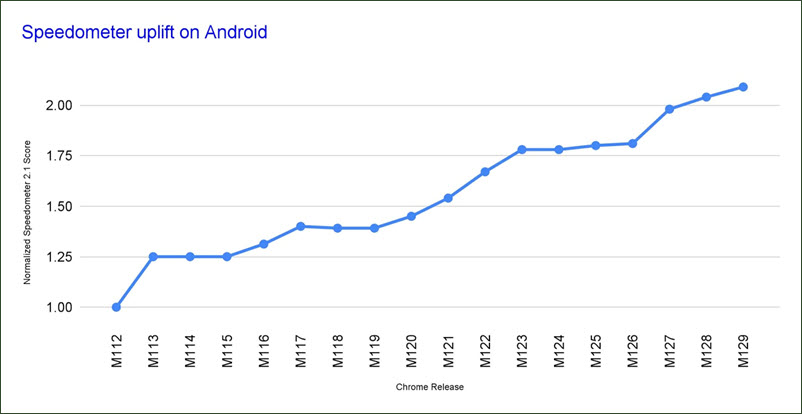
Enhancements to Chrome’s JavaScript engine, V8, and rendering engine, Blink, have also contributed to these performance gains. Collaborations with Android partners and System on Chip (SoC) manufacturers optimized interactions with the operating system and thread scheduling, maximizing hardware capabilities. These efforts have led to more than doubling Speedometer 2.1 scores on many Android devices since Chrome v112, with premium devices achieving record-breaking performance.
For end users, these improvements translate to faster page loads and smoother interactions, enhancing the overall browsing experience on Android devices. Interested users can check speedometer score of their browser installation on this page.
(via Chromium Blog)